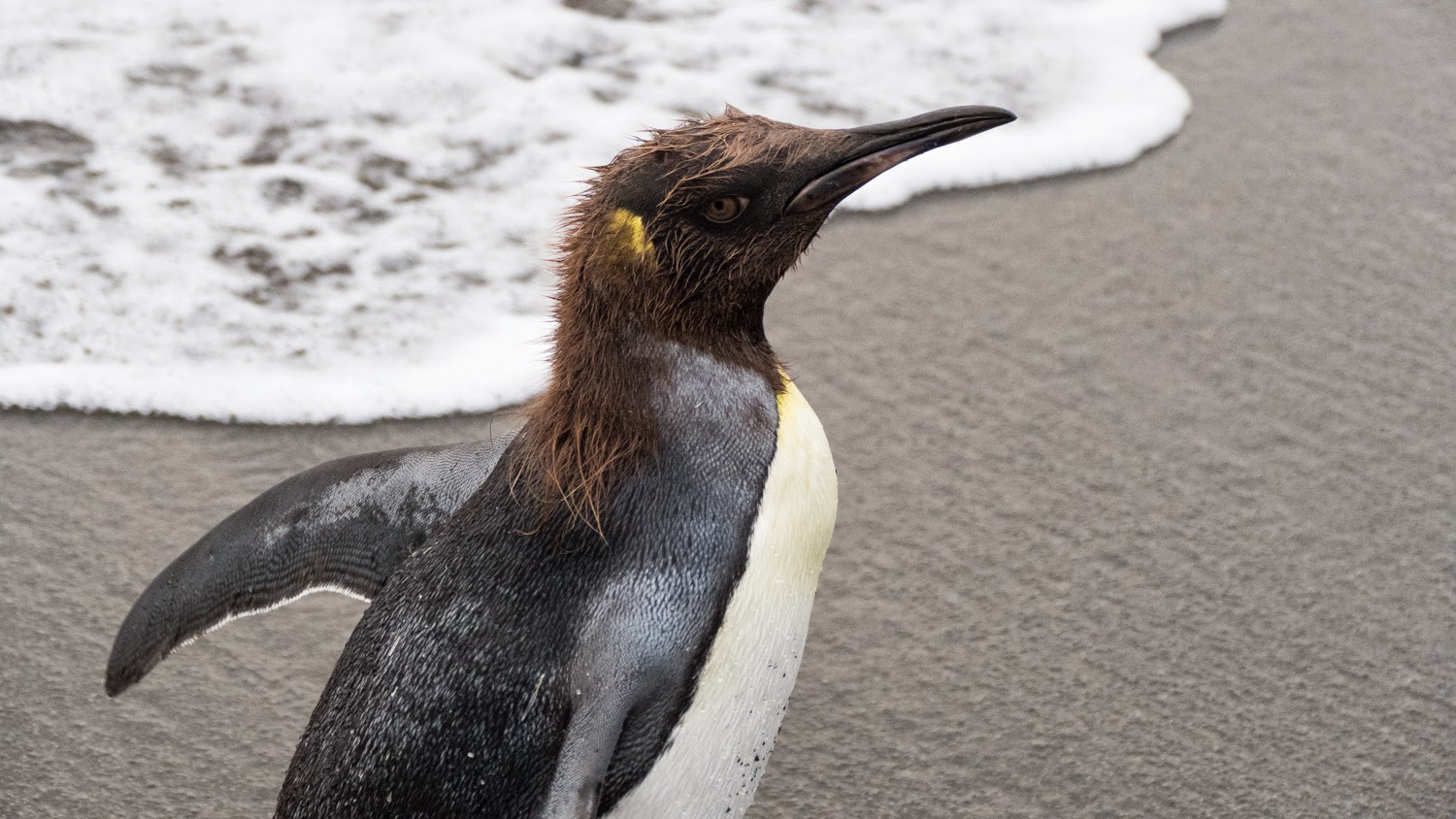
Before we get started, let us level the playing field by recognizing that growing up is tough work. This stands as a universal truth for every species on our planet, but few have such a dynamic and aesthetically hysterical transition as the offspring of King Penguins.
Long before their golden sheen develops, they are forced to spend their beginning days on shore taking what food their parents offer until they shed their dense juvenile feathers and are able to swim and feed themselves.
Initially, they appear much larger than they actually are with brown feathers dry and fluffed. At this point, they are known as Oakum Boys – a term adopted from the loose fibers that were dipped in tar and used to caulk the occasional hole in a wooden ships.
Because of their size, it takes King Penguins chicks 14-16 months before they reach adult plumage and are ready to hunt on their own and the transition of feathers is never simultaneous. Leaving all manner of outrageous ‘hair cuts’ to marvel at.
As with all things, not all of the chicks will live to reach adulthood, but those who do will create one of the largest concentrations of life able to be witnessed in one place – South Georgia island.
Until that time though, they are perfectly fine prancing their youthful punk for anyone wishing to see.
Underwater wildlife encounters from around the world. Follow along for natural history and other brash reports from the happenings.
Showing posts with label life cycle. Show all posts
Saturday, February 21, 2015
Saturday, January 17, 2015
Killer Whale attack in the Southern Ocean
12/04/14 - Searching the waters on the west side of the Antarctic Peninsula the National Geographic Explorer encountered a pod of Type A Killer Whales trying to separate a Minke whale calf from its mother.

Type A Killer Whales are the largest of all Killer Whale on our planet. Easily recognized by their very large white eye patch, these apex predators are known for their keen strategies that succeed in taking down much larger prey.
Successfully separating the calf from its mother, the pod decided to split. Half staying to begin the work of drowning the Minke calf, while the others pursued the mother to see if they could add her to the menu.
In perfect unison, the pod toppled upon the calf. Denying it the ability to break the surface in order to breathe. Here we see the calf lunging for air as the pursuit continues.

Greatly outnumbered, the Minke whale calf had little chance of survival. Here we see a large male biting down on the submerged calf.
And the resulting wound.
Wounded and exhausted the Minke calf makes one last attempt to breathe.
Before succumbing to the inevitable.
It was our great luck to have two NOAA whale biologists on board - Dr. John Durban & Dr. Holly Fearnbach. With a cross bow delivery system, they tag these Killer Whale populations with satellite transmitters enabling a wealth of data to be collected concerning the behaviors and locations of these magnificent creatures. Note the satellite tag attached to the end of the arrow.
With each tag costing several thousand dollars, Dr. Durban must wait for the perfect shot in order that the tag stick firmly within the dorsal fin. This ensures that it will stay fixed and transmitting for 3-4 months.
As John waits for his moment to fire, we witness the true size of this male. That dorsal fin can reach six vertical feet. Killer Whales this size are not found anywhere else in the world.
Successfully tagging several Killer Whales this day, John & Holly are now tracking their movements and YOU CAN TOO!!!
CLICK HERE to go to NOAA's website to track these Killer Whales.
In the right hand column, click on the drop down menu for WHALES and select Dec 4 as the date to track these specific Killer Whales. A very unique opportunity to follow along - too cool not to share!
Photos by Paul North - follownorth.com
CLICK HERE to join FOLLOWNORTH's email list for updates.
Labels:
antarctica,
apex,
killer whales,
life cycle,
lindblad,
marine biology,
marine mammals,
national geographic,
natural history,
NOAA,
ocean,
orca,
predation,
satellite tagging,
southern ocean,
whales
Wednesday, January 14, 2015
Penguin Colony Lifecycle on the Antarctic Peninsula.
After a two day crossing of the Drake Passage, the National Geographic Explorer steered a course toward the penguin colonies upon Brown Bluff. Being the northernmost tip of the Antarctic Peninsula, it is a known location for penguin colonies.
Waiting for the austral summer to commence, the penguins know exactly when to come to ground to begin preparations. As the ice clears, moss and lichen begin to show their colors once again. Here Adélie penguins gather in great numbers and choose to nest in close quarters. This can make nest building a bit of a competitive sport.
Choosing which beach rocks to build with is important and competition is everywhere.
Neighbors are not to be trusted, often stealing a rock away when someone is not looking. But there is satisfaction when finding a mate who can help with the work load.
Once the chicks are hatched they are still in need of the parents warmth and protection.
And of course, the free meals that they provide.
This Brown Skua is one of the many predators that a penguin colony must endure. Patiently waiting at the edge of the colony, it seeks out those who stray too far from their parents' protection.
Unattended eggs also make a meal. Trading a life so that another may go on. As gruesome as this may seem, it is a necessary factor in maintaining the equilibrium of the colony's population.
The cold climate can preserve remains. Telling the story of survival in a landscape riddled with dangers.
And once the breeding season has run its course and the chicks are grown, it is back to the waters of the Southern Ocean to seek food and furtherance for these hearty, flightless birds.
Click to join Follow North's email list for updates.
Labels:
adelie,
adventure,
animals,
antarctic peninsula,
antarctica,
austral summer,
breeding,
chicks,
conservation,
glaciers,
ice,
life cycle,
natural history,
nests,
ocean,
penguins,
skua,
travel,
wildlife
Subscribe to:
Posts (Atom)