Showing posts with label travel. Show all posts

Monday, August 24, 2015

Christmas in Antarctica!


Just signed up for a month of underwater exploration in Antarctica spanning Christmas and New Years. With its unnamed invertebrates, below freezing temperatures, and carnivorous seals that stretch the length of a mid-size car, our earth's most southern continent is a place of wondrous finds.

Swimming amidst grounded icebergs and penguins while losing sensation in your lips from the 29F/-1.6C water is the kind of diving that challenges the mind, body and whatever other ingredients make us human.

For laughs, I have included a link of some hijinks Patrick Gilmore and I got into when exploring the islands and channels of the Antarctic Peninsula aboard the National Geographic Explorer.

Penguins: High Def vs. Standard Def

As well as the recent article from scientist Skye Moret using my underwater images to compare the color differences between what is above and below the waters off the white continent.

In Living Color: Antarctica's Vibrant Wildlife Under the Sea

Saturday, May 23, 2015

My First Magazine Cover - The Walden Quarterly


Spring 2015 issue - featuring an 8 page spread of photography from Antarctica, Alaska, and other far flung locales and including an interview that attempts to explain what exactly an Undersea Specialist gets up to down there.

Saturday, February 21, 2015

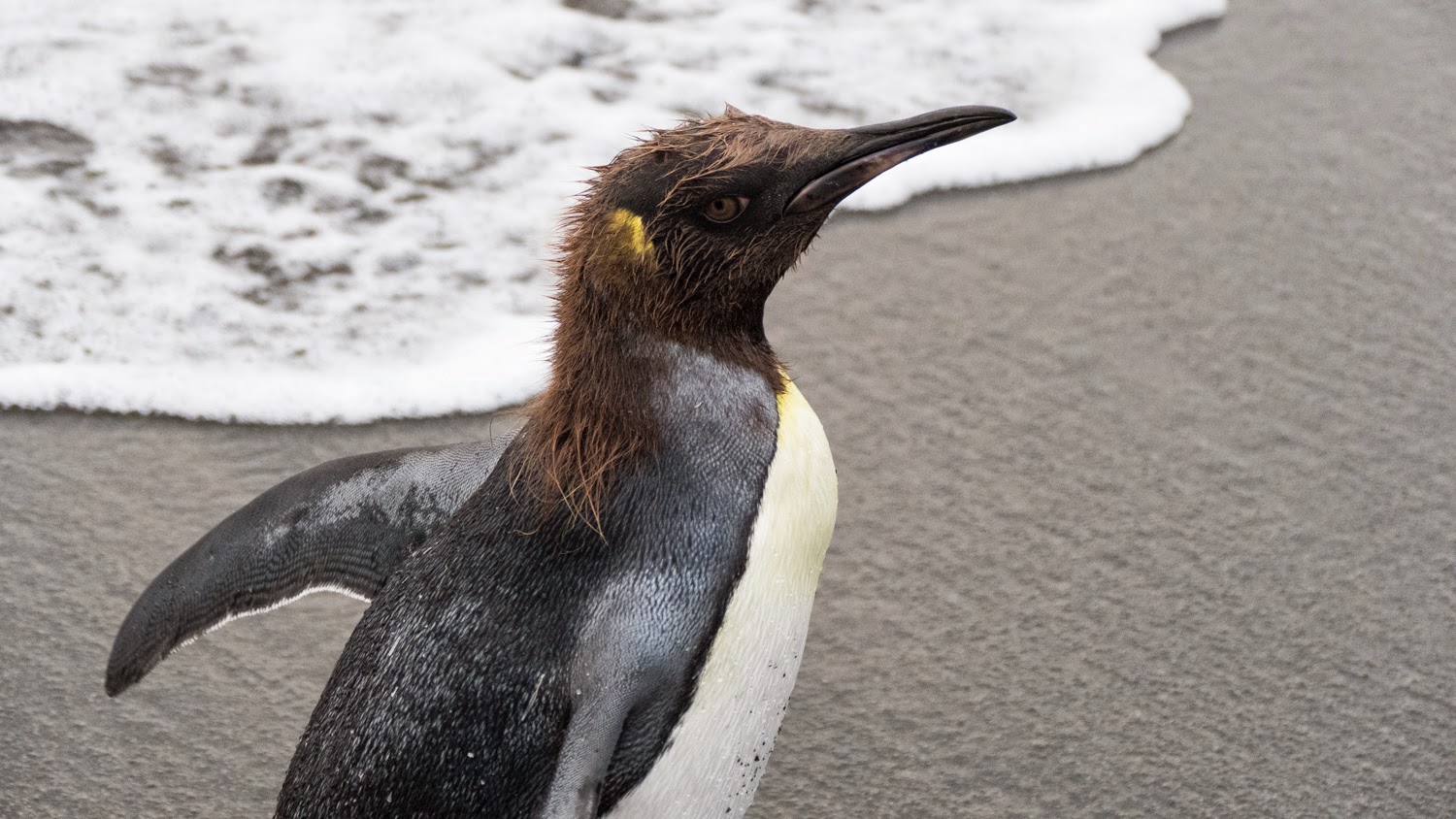
Ugly Chick Competition – King Penguins

Before we get started, let us level the playing field by recognizing that growing up is tough work. This stands as a universal truth for every species on our planet, but few have such a dynamic and aesthetically hysterical transition as the offspring of King Penguins.

Long before their golden sheen develops, they are forced to spend their beginning days on shore taking what food their parents offer until they shed their dense juvenile feathers and are able to swim and feed themselves.


Initially, they appear much larger than they actually are with brown feathers dry and fluffed. At this point, they are known as Oakum Boys – a term adopted from the loose fibers that were dipped in tar and used to caulk the occasional hole in a wooden ships.


Because of their size, it takes King Penguins chicks 14-16 months before they reach adult plumage and are ready to hunt on their own and the transition of feathers is never simultaneous. Leaving all manner of outrageous ‘hair cuts’ to marvel at.


As with all things, not all of the chicks will live to reach adulthood, but those who do will create one of the largest concentrations of life able to be witnessed in one place – South Georgia island.


Until that time though, they are perfectly fine prancing their youthful punk for anyone wishing to see.


Wednesday, February 11, 2015

Antarctic Fur Seal Encounters

Waking at 3:30am just off of South Georgia Island to catch the rising sun, I was filled with great anticipation to encounter one of the largest King Penguin colonies in the world. Reaching the beach though, I could not help but be charmed by the numerous Antarctic Fur Seal pups guarding the shore.


If you have not heard of South Georgia Island, it is because it is about as remote as islands get in the Atlantic. Nearly 900 nautical miles east of the bottom tip of South America, it is the perfect place for all manner of sea birds to come to breed. It tops the list of any bird lover wanting to see dense populations and wide variety, but it is also where 95% of Antarctic Fur Seals choose to breed and bear their young.


Hunted near to extinction at the height of the whaling days in the Southern Ocean, these Fur Seals have enjoyed a massive rebound in numbers. This was evident the moment our feet touched the beach as the smallest of pups boldly charged us, bearing their teeth as if to attack only to turn at the last second realizing their large disadvantage in size.


This behavior forces me to say how cute they are, but cute they will not remain!

The males specifically will grow into large, toothy fighting machines – reaching over 400 pounds. Like many seals they will fight for control over a harem of females in order that the strongest of their species survive and from the beginning the pups practice for the wars to come.

For now though, the large males were entirely absent. Having done the work of the mating season, they have returned out to feed on the abundant krill in the cold waters. Each consuming up to one ton of krill per year!

I, for one, enjoy the knowledge of what they will become. It allows a greater appreciation for the playful practices witnessed. I have more than a thousand King Penguin photos to edit and I promise to post them soon. Until then enjoy unassuming innocence of these small wonders.

Wednesday, January 28, 2015

Seabirds of the Drake Passage

Headed out from our embarkation port of Ushuaia, Argentina the National Geographic Orion pointed south toward the Antarctic Peninsula. Followed by a myriad of sea birds, I enjoyed the challenge of trying to capture them on film as they swooped past our vessel using the updraft to cruise above the waves.

Sooty Albatross

These birds spend the majority of their lives flying above the open ocean. Only returning to land when the season calls for them to mate and hatch their young. Using the strong westerly winds, it is rare to see them flap their wings.

Pintado Petrel

Conserving their energy, some are even known to spend weeks at a time without landing due to the consistency of the wind and its ability to carry them many hundreds of miles in search of available food.

Black Browed Albatross

Southern Petrel

I never thought I would consider an albatross sighting to be a common thing, but after seeing more than a hundred I now view them as welcome travelling companions.

Click here to join follownorth's email update list for more natural history postings.

Monday, January 26, 2015

My First Dive in Antarctica - Neptune's Bellows

December 2014 - 62°58′37″S 60°39′00″W

After a two day crossing of the Drake Passage, the National Geographic Explorer came upon Deception Island. Part of the South Shetlands archipelago and one of the safest harbors in the Antarctic, the island fooled whaling boats for many years. Causing them to sail on by without knowledge of the narrow entry and the safety therein.


The islands hidden nature is caused by the collapse of land following a volcanic eruption. Known as caldera, you may already be familiar with this geological phenomenon if you know of Oregon's Crater Lake. But whereas that is filled with crystal blue fresh water, Deception Island is open to the changing tides of the Southern Ocean.

Joined by my team of divers, Oscar Johansson and Jesper Westermark, the Baker and Head Chef onboard our vessel, we set off to dive the narrow entrance to Deception Island known as NEPTUNE'S BELLOWS. With a strong current and 30F water (-1C) it was not a place for any tomfoolery. Not to mention the potential traffic of large ships passing through.


Whereas Antarctica itself is considered a desert we quickly found that not to be the case underwater. Large Frond Tang (Kelp) stretched up to 8 meters curtaining down from the vertical walls leftover from the volcano's collapse.


Barely an inch of the islands substrate was visible. Covered entirely by sponges competing for real estate.


It was not until the late 1800's that we even realized that sponges were part of the Animal Kingdom. Now, the more we study them the more we learn how vital the role they play is in filtering our ocean's water. Here we see a magnified close up I was able to capture off of Haida Gwaii last summer. Note just how many canals there are for water to pass through which feeds the sponge and cleans the water simultaneously.


Descending to 92 feet, we found all manner of invertebrates. The most interesting being this isopod measuring nearly 5 inches as he reached out with antennae to see who was obstinate enough to put a camera in his face. Many more Antarctic dives to be posted, but there is nothing like the first!

Wednesday, January 14, 2015

Penguin Colony Lifecycle on the Antarctic Peninsula.

After a two day crossing of the Drake Passage, the National Geographic Explorer steered a course toward the penguin colonies upon Brown Bluff. Being the northernmost tip of the Antarctic Peninsula, it is a known location for penguin colonies.
Waiting for the austral summer to commence, the penguins know exactly when to come to ground to begin preparations. As the ice clears, moss and lichen begin to show their colors once again.
Here Adélie penguins gather in great numbers and choose to nest in close quarters. This can make nest building a bit of a competitive sport.
Choosing which beach rocks to build with is important and competition is everywhere.
Neighbors are not to be trusted, often stealing a rock away when someone is not looking.
But there is satisfaction when finding a mate who can help with the work load.

Once the chicks are hatched they are still in need of the parents warmth and protection.

And of course, the free meals that they provide.

This Brown Skua is one of the many predators that a penguin colony must endure. Patiently waiting at the edge of the colony, it seeks out those who stray too far from their parents' protection.

Unattended eggs also make a meal. Trading a life so that another may go on. As gruesome as this may seem, it is a necessary factor in maintaining the equilibrium of the colony's population.

The cold climate can preserve remains. Telling the story of survival in a landscape riddled with dangers.

And once the breeding season has run its course and the chicks are grown, it is back to the waters of the Southern Ocean to seek food and furtherance for these hearty, flightless birds.

Click to join Follow North's email list for updates.

Sunday, January 11, 2015

The Brush-Tail Penguins of Antarctica

Ending 2014 with a journey to the white continent of Antarctica was a dream. Working as the Undersea Specialist with Lindblad Expeditions/National Geographic allowed for many amazing wildlife encounters. Chief among them was meeting all three species of Brush-tail Penguins.

Generally described as 'cute' - I feel this word undermines the endurance and creativity of these survivors. Living in the most unforgiving environment on our planet, they swim, waddle, surf, and build in order to secure the future of their species.


Brush-tail #1: The Gentoo Penguins carefully select their rocks with which to build their nests.


Brush-tail #2: The Adélie Penguin heading to the ocean to feed.


Brush-tail #3: Chin-strap Penguins inspecting the water for predators before they dive in.

Many more photos of these little ones on the way. Until then I leave you with a picture of me in front of our mighty ice breaking vessel the National Geographic Explorer.


Click here to join Follow North's email update list.

Friday, January 9, 2015

Website Launch - FollowNorth.com

Greetings,

My name is Paul North. This website launches my effort to share the explorations and adventures of diving in some of earth's most remote and wondrous marine ecosystems.

With the privilege of working with Lindblad Expeditions/National Geographic as an Underwater Videographer and Naturalist, my job is to film what I find on my dives and present the natural history of the experience to the guests on-board.

2015 is well booked. Antarctica. Baja California. Alaska. Iceland. Greenland. The Canadian Arctic. Fiji. Tahiti & Easter Island.

Lots to explore on the site currently. Recent trips to Antarctica, Baja California, and Alaska are posted now.

FollowNorth.com

The blog is featured on the website and will update often with stories of marine wildlife encounters.

To begin, a link to Diving Alaska - a video collaboration using my footage and the music of the very talented composer - Vin Gast

Follow along to join me in the experience.

Join FollowNorth's email list for updates.


Thursday, January 1, 2015

Inhale. Exhale. Evolve. - 2014 in Review

Greetings, my name is Paul North and I work as Undersea Specialist with Lindblad Expeditions/National Geographic filming and photographing some of our earth's most vibrant underwater ecosystems. 2014 has been a year of great adventure and the coming year looks to be much the same. What I hope to share with this blog is a continued view toward our ocean as a whole.

Increasing our understanding of the creatures inhabiting these waters is the only way to strike back against the damage already done. Thus here I will be sharing photos, videos, and the natural history of my encounters. Follow with me in 2015 as I venture from Alaska to Antarctica, Fiji, Tahiti, the Arctic & beyond searching for life and meaning within the water.


Click here to sign up to FollowNorth's email list.