Showing posts with label penguins. Show all posts

Monday, August 24, 2015

Christmas in Antarctica!


Just signed up for a month of underwater exploration in Antarctica spanning Christmas and New Years. With its unnamed invertebrates, below freezing temperatures, and carnivorous seals that stretch the length of a mid-size car, our earth's most southern continent is a place of wondrous finds.

Swimming amidst grounded icebergs and penguins while losing sensation in your lips from the 29F/-1.6C water is the kind of diving that challenges the mind, body and whatever other ingredients make us human.

For laughs, I have included a link of some hijinks Patrick Gilmore and I got into when exploring the islands and channels of the Antarctic Peninsula aboard the National Geographic Explorer.

Penguins: High Def vs. Standard Def

As well as the recent article from scientist Skye Moret using my underwater images to compare the color differences between what is above and below the waters off the white continent.

In Living Color: Antarctica's Vibrant Wildlife Under the Sea

Monday, June 22, 2015

In Living Color: Antarctica's Vibrant Wildlife Under the Sea

Mostly when Antarctica is mentioned, the first color one thinks of is white. An easy conclusion to reach given that the majority of the continent is thickly covered in ice, but a recent collaborative experiment between scientist Skye Moret and I has yielded far more colorful results.

In Living Color: Antarctica's Vibrant Wildlife Under the Sea

Asking for 50 of my most boldly colored dive images from the two months I spent exploring the Southern Ocean earlier this year, she then paired them against 50 of her own images from above the water to see what might be realized when comparing the two worlds.

Devising a way to represent the information in the most compelling manner, Skye crafted a pixellated color bar to represent the variance in each image individually. Fascinating in their own right, simply because we spend so little time dwelling on the inhabitants of our most southern continent, the color bars take on a whole new appearance when placed together.


In Living Color: Antarctica's Vibrant Wildlife Under the Sea

Published by The Ground Truth Project at Medium, Skye writes of her time aboard research vessels in the Southern Ocean and how such a project came to form in her mind.

Check out the recent article in the Boston Globe about Skye's work: Teaching Scientists How to Visualize Their Data

Also not to be missed her website where science and a designer's imagination meet: Skye Moret

In Living Color: Antarctica's Vibrant Wildlife Under the Sea

FOLLOWNORTH.COM

Click here to join FOLLOWNORTH's email list.

Saturday, May 23, 2015

My First Magazine Cover - The Walden Quarterly


Spring 2015 issue - featuring an 8 page spread of photography from Antarctica, Alaska, and other far flung locales and including an interview that attempts to explain what exactly an Undersea Specialist gets up to down there.

Tuesday, March 17, 2015

Shackleton's Ghost

Perhaps you have heard of Shackleton and the Trans-Antarctic Expedition. Perhaps you have even given consideration to the perils those men faced in order to survive months spent in the most unforgiving place on our planet.


But even now on the centennial of the event with the myriad of books and documentaries that cover the topic so well, we will still never know. It is not our fault. We just were not there. Unless we feel the numb that the cold forces or the hunger that brews madness, how can we ever understand what it takes to overcome it?


Were it not for Shackleton's unyielding and humored leadership, who knows what the final tally of survivors would have been - most likely none at all. Though his attempts to make the South Pole failed, the story of how he tended to the fires of his men's spirits is what makes him the legend amongst the role call of polar explorers.

Recently, I had the fortune to set out aboard the National Geographic Orion to trail the path of survival Shackleton and his men took. Not shying away from authenticating the journey, we took the vessel into the Weddell Sea and planted her firmly into the sea ice for an afternoon of snow ball fights and champagne.


After a week spent investigating the Antarctic peninsula enjoying the marine mammals and brush tailed penguins, we crossed the Scotia Sea to reach Elephant Island. Like Shackleton and his men, we first came to Cape Valentine but it was as clear to us, as it must have been one hundred years before, that this was not an ideal place to make camp.


Next we arrived at Point Wild - the location where the men decided to make camp. Hiding behind the glacier to protect themselves from the wind, the James Caird was made ready for Shackleton and some hand picked companions to make the 800 nautical mile journey across to South Georgia.


Following their track, we reached Cape Rosa, South Georgia. It was on this island that they would eventually find rescue at Stromness Whaling Station, but not before climbing through the middle of the night across the jagged peaks that separated them from the other side of the island.


The details have been accounted for. The story of Shackleton is told, but what resonants most is his refusal to die. A stubbornness that he infused in all of his men to keep them alive (even the stowaway). In this modern day, we call many leader, but have sparse examples as to what that should mean.


Shackleton now lies at Grytviken, a ghost of another of the whaling stations that populated South Georgia during the era.


Standing amidst the ruins gives one a sense for the world that was. Men of industry and adventure who turned down the coming world war for a chance to place a foot on untouched soil. These days such exploits are reserved for space and the ocean's depth and in those journeys we can only hope that another Shackleton will arise.


Saturday, February 21, 2015

Ugly Chick Competition – King Penguins

Before we get started, let us level the playing field by recognizing that growing up is tough work. This stands as a universal truth for every species on our planet, but few have such a dynamic and aesthetically hysterical transition as the offspring of King Penguins.

Long before their golden sheen develops, they are forced to spend their beginning days on shore taking what food their parents offer until they shed their dense juvenile feathers and are able to swim and feed themselves.


Initially, they appear much larger than they actually are with brown feathers dry and fluffed. At this point, they are known as Oakum Boys – a term adopted from the loose fibers that were dipped in tar and used to caulk the occasional hole in a wooden ships.


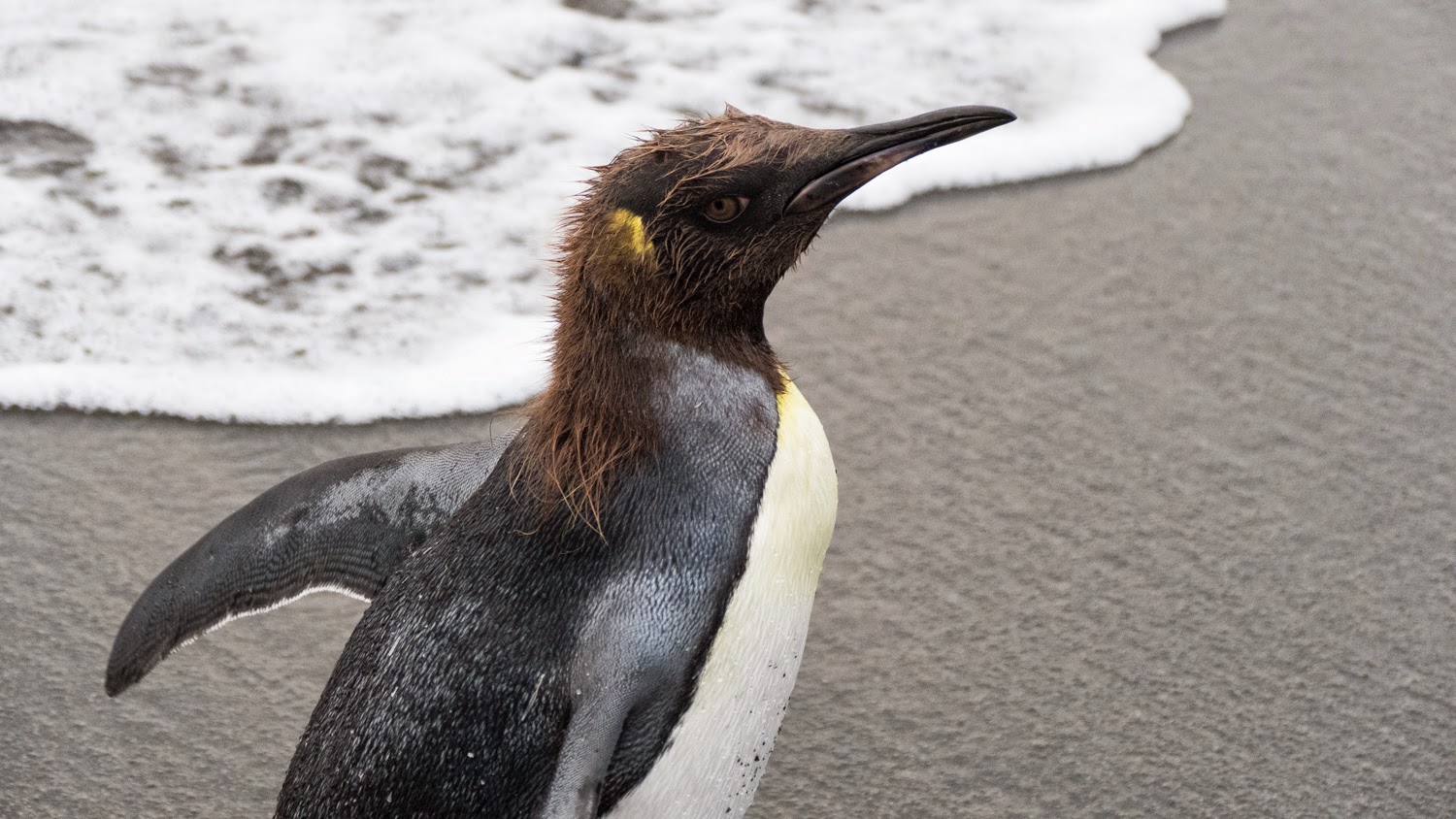
Because of their size, it takes King Penguins chicks 14-16 months before they reach adult plumage and are ready to hunt on their own and the transition of feathers is never simultaneous. Leaving all manner of outrageous ‘hair cuts’ to marvel at.


As with all things, not all of the chicks will live to reach adulthood, but those who do will create one of the largest concentrations of life able to be witnessed in one place – South Georgia island.


Until that time though, they are perfectly fine prancing their youthful punk for anyone wishing to see.


Monday, February 16, 2015

King Penguins of South Georgia Island

Whether or not we have the capacity to admit it, much of the world we know was segmented long before we had the chance to experience it. We cherish the natural world, but are rarely able to see it without boundaries. So when I learned that I would be traveling to South Georgia Island - a remote landscape in the South Atlantic - I began to do research to get a sense for what I would see. It was not until I arrived though that the full impact of the wildlife began to effect me.


Both my eyes and camera had trouble focusing due to the vast numbers of King Penguins taking over the landscape from the surf line continuing way back in the hills where glaciers hung.


The second largest of all penguin species after the Emperors, King Penguins can stand over 3 feet tall. Reaching their adult plumage, they appear as if painted.


Their feathers have great complexity, layered in a way to make them completely water proof. Combined with the ability to control each feather individually, these King Penguins can quickly air themselves out to dry when on land.


And as the seasons turn they molt the old feathers to make room for the new.


South Georgia is a rare place in this crowded world. An island absent of man, except for the few who stand steadfast to guard it. The amount of life sends a shock through the system. Reminding one of what the world was before our innovation began to wear away at it.


Many more King Penguin photos to come!

Click here to sign up for my email list to receive updates!

And check out my website for more photography and natural history: FOLLOWNORTH.COM

Tuesday, February 3, 2015

Leopard Seal Encounters

It has been a quite a wait, but it was well worth it. Out of all the creatures living on this earth (that we know about) the Leopard Seal has been on the top of my list ever since I learned of its existence. Why am I getting so excited about a seal that reaches over 12 feet and can put down 20+ penguins a day without blinking? Maybe a few pictures can help answer that question…

Outside of Killer Whales there are no marine mammals regarded as such pure and cunning hunters. Patrolling the waters of the Southern Ocean, Leopard Seals are mainly found in Antarctica.

Though not as quick as the variety of penguin species that they hunt, they use the surrounding icebergs to hide until the opportune moment when the penguins leave their nesting grounds and reenter the water.

Able to open their mouth to a gaping 120 degrees, these Leopard Seals take quick hold of their prey before thrashing them violently in order to remove the skin and feathers entirely from the captured penguins.

Vicious? Yes. Beautiful? Absolutely. Continuing to dive in Antarctic waters I can only hope that one is curious enough to one day swim over and interact with me.


Wednesday, January 14, 2015

Penguin Colony Lifecycle on the Antarctic Peninsula.

After a two day crossing of the Drake Passage, the National Geographic Explorer steered a course toward the penguin colonies upon Brown Bluff. Being the northernmost tip of the Antarctic Peninsula, it is a known location for penguin colonies.
Waiting for the austral summer to commence, the penguins know exactly when to come to ground to begin preparations. As the ice clears, moss and lichen begin to show their colors once again.
Here Adélie penguins gather in great numbers and choose to nest in close quarters. This can make nest building a bit of a competitive sport.
Choosing which beach rocks to build with is important and competition is everywhere.
Neighbors are not to be trusted, often stealing a rock away when someone is not looking.
But there is satisfaction when finding a mate who can help with the work load.

Once the chicks are hatched they are still in need of the parents warmth and protection.

And of course, the free meals that they provide.

This Brown Skua is one of the many predators that a penguin colony must endure. Patiently waiting at the edge of the colony, it seeks out those who stray too far from their parents' protection.

Unattended eggs also make a meal. Trading a life so that another may go on. As gruesome as this may seem, it is a necessary factor in maintaining the equilibrium of the colony's population.

The cold climate can preserve remains. Telling the story of survival in a landscape riddled with dangers.

And once the breeding season has run its course and the chicks are grown, it is back to the waters of the Southern Ocean to seek food and furtherance for these hearty, flightless birds.

Click to join Follow North's email list for updates.

Sunday, January 11, 2015

The Brush-Tail Penguins of Antarctica

Ending 2014 with a journey to the white continent of Antarctica was a dream. Working as the Undersea Specialist with Lindblad Expeditions/National Geographic allowed for many amazing wildlife encounters. Chief among them was meeting all three species of Brush-tail Penguins.

Generally described as 'cute' - I feel this word undermines the endurance and creativity of these survivors. Living in the most unforgiving environment on our planet, they swim, waddle, surf, and build in order to secure the future of their species.


Brush-tail #1: The Gentoo Penguins carefully select their rocks with which to build their nests.


Brush-tail #2: The Adélie Penguin heading to the ocean to feed.


Brush-tail #3: Chin-strap Penguins inspecting the water for predators before they dive in.

Many more photos of these little ones on the way. Until then I leave you with a picture of me in front of our mighty ice breaking vessel the National Geographic Explorer.


Click here to join Follow North's email update list.