Mostly when Antarctica is mentioned, the first color one thinks of is white. An easy conclusion to reach given that the majority of the continent is thickly covered in ice, but a recent collaborative experiment between scientist Skye Moret and I has yielded far more colorful results.
In Living Color: Antarctica's Vibrant Wildlife Under the Sea
Asking for 50 of my most boldly colored dive images from the two months I spent exploring the Southern Ocean earlier this year, she then paired them against 50 of her own images from above the water to see what might be realized when comparing the two worlds.
Devising a way to represent the information in the most compelling manner, Skye crafted a pixellated color bar to represent the variance in each image individually. Fascinating in their own right, simply because we spend so little time dwelling on the inhabitants of our most southern continent, the color bars take on a whole new appearance when placed together.
In Living Color: Antarctica's Vibrant Wildlife Under the Sea
Published by The Ground Truth Project at Medium, Skye writes of her time aboard research vessels in the Southern Ocean and how such a project came to form in her mind.
Check out the recent article in the Boston Globe about Skye's work: Teaching Scientists How to Visualize Their Data
Also not to be missed her website where science and a designer's imagination meet: Skye Moret
In Living Color: Antarctica's Vibrant Wildlife Under the Sea
FOLLOWNORTH.COM
Click here to join FOLLOWNORTH's email list.
Underwater wildlife encounters from around the world. Follow along for natural history and other brash reports from the happenings.
Showing posts with label nature photography. Show all posts
Monday, June 22, 2015
In Living Color: Antarctica's Vibrant Wildlife Under the Sea
Labels:
adelie,
antarctic peninsula,
antarctica,
austral summer,
groundtruth,
lindblad,
marine biology,
marine mammals,
medium,
national geographic,
nature,
nature photography,
penguins,
science,
scuba,
scuba diving
Location:
Antarctica
Sunday, May 31, 2015
The Wilds of Alaska
Alaska provides.
Redefining our notions of wilderness.
Eliminating the gap that we imagine exists between ourselves and the natural world.
Letting us breathe again.
Far away from the stains with which we have colored the world.
And if it is only for a day, then a good day it is to reset our expectations for how we should interact with the creatures inhabiting this world.
Redefining our notions of wilderness.
Eliminating the gap that we imagine exists between ourselves and the natural world.
Letting us breathe again.
Far away from the stains with which we have colored the world.
And if it is only for a day, then a good day it is to reset our expectations for how we should interact with the creatures inhabiting this world.
Monday, April 27, 2015
Fresh Back from Baja California
"Yet we must choose each step we take with utmost caution, for the footprints we leave behind are as important as the path we will follow. They’re part of the same journey..." - excerpt from Dance of the Chupacabras
I have recently returned from three weeks of eye contact with dolphins.
Some ocean vibrance while on land.
And plenty of reasons to return.
More stories and photos on there way soon!
Join FOLLOWNORTH'S EMAIL LIST HERE
www.follownorth.com
I have recently returned from three weeks of eye contact with dolphins.
Some ocean vibrance while on land.
And plenty of reasons to return.
More stories and photos on there way soon!
Join FOLLOWNORTH'S EMAIL LIST HERE
www.follownorth.com
Labels:
baja california,
dolphins,
marine mammals,
national geographic,
natural history,
nature,
nature photography,
ocean,
osprey,
sea of cortez,
street art,
travel photography
Location:
Gulf of California
Friday, April 10, 2015
Befriending the Leviathan – The Gray Whales of Baja California
How easily we draw the line that separates us from the wild. Presuming that our ability to name the creatures of this world somehow separates us from them, and worse yet gives us dominion to do with them as we please.
Yet out of all the places in the world where we have abused animal life as a resource, none tell a more magical tale than the lagoon of San Ignacio in Baja California where the California Gray Whales have suffered both slaughter and revival.
Beginning in 1845, these whales were found to be easy prey for the bold whalers that chose to hunt them. Injuring the newly born calves, the whalers knew that the mother would seek to help her young, thus dooming herself to die under the heft of their spears. Such hunting was easily accomplished with the known breeding grounds with water too shallow for the whales to dive and escape.
Without conscience, the slaughter brought the California Gray Whales down to the brink of extinction with population estimates at only 250 whales remaining in the North Pacific at the time. Luckily, Mexico stepped up and became the first country to enact protection over these magnificent and intelligent creatures, and over the last one hundred plus years the whales have been recovering and greatly adding to their numbers.
With the fortune of visiting the lagoon aboard the National Geographic Sea Lion, I was privileged to encounter these marine mammals in the very place that they are born. In the shallows water, the mother’s exercise their young against the current to prepare them for the five thousand mile journey to the feeding grounds of Alaska.
Once known as the Devil Fish for how fiercely they fought against the whalers, the Gray Whale mothers now, unbelievably, encourage their calves to approach. Out of all the marine mammals encounters that I have enjoyed, this one takes the prize.
Petting the calves as they rolled and rubbed our zodiac, I was close enough to look into their eyes, see the newly growing hairs that remind of the heritage that we share, and even get my hat blown off when they exhaled.
Words have no place in trying to describe the experience, thus I share some of the images I was able to capture with hope that the reader will be as endeared to them as I am, and perhaps visit such a place for themselves one day.
Join FOLLOWNORTH’s email list by clicking here.
FOLLOWNORTH.COM
All photos © Paul North (unless otherwise noted)
Yet out of all the places in the world where we have abused animal life as a resource, none tell a more magical tale than the lagoon of San Ignacio in Baja California where the California Gray Whales have suffered both slaughter and revival.
Beginning in 1845, these whales were found to be easy prey for the bold whalers that chose to hunt them. Injuring the newly born calves, the whalers knew that the mother would seek to help her young, thus dooming herself to die under the heft of their spears. Such hunting was easily accomplished with the known breeding grounds with water too shallow for the whales to dive and escape.
Without conscience, the slaughter brought the California Gray Whales down to the brink of extinction with population estimates at only 250 whales remaining in the North Pacific at the time. Luckily, Mexico stepped up and became the first country to enact protection over these magnificent and intelligent creatures, and over the last one hundred plus years the whales have been recovering and greatly adding to their numbers.
With the fortune of visiting the lagoon aboard the National Geographic Sea Lion, I was privileged to encounter these marine mammals in the very place that they are born. In the shallows water, the mother’s exercise their young against the current to prepare them for the five thousand mile journey to the feeding grounds of Alaska.
Once known as the Devil Fish for how fiercely they fought against the whalers, the Gray Whale mothers now, unbelievably, encourage their calves to approach. Out of all the marine mammals encounters that I have enjoyed, this one takes the prize.
Petting the calves as they rolled and rubbed our zodiac, I was close enough to look into their eyes, see the newly growing hairs that remind of the heritage that we share, and even get my hat blown off when they exhaled.
Words have no place in trying to describe the experience, thus I share some of the images I was able to capture with hope that the reader will be as endeared to them as I am, and perhaps visit such a place for themselves one day.
Join FOLLOWNORTH’s email list by clicking here.
FOLLOWNORTH.COM
All photos © Paul North (unless otherwise noted)
Labels:
baja,
california,
conservation,
ecotourism,
gray whales,
lindblad expeditions,
marine mammals,
mexico,
national geographic,
natural history,
nature photography,
ocean,
underwater photography,
whales
Location:
Baja California, Mexico
Saturday, February 21, 2015
Ugly Chick Competition – King Penguins
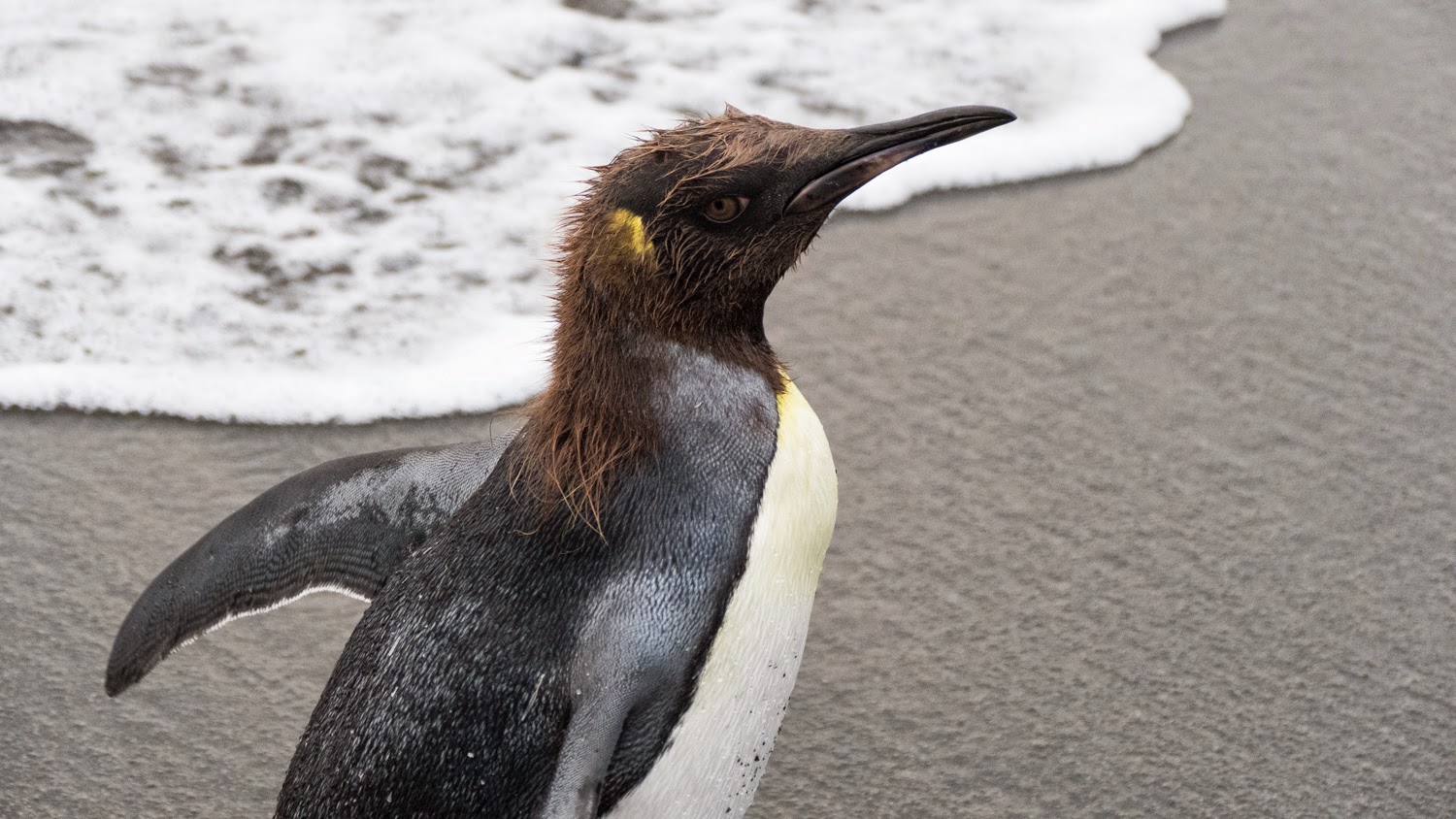
Before we get started, let us level the playing field by recognizing that growing up is tough work. This stands as a universal truth for every species on our planet, but few have such a dynamic and aesthetically hysterical transition as the offspring of King Penguins.
Long before their golden sheen develops, they are forced to spend their beginning days on shore taking what food their parents offer until they shed their dense juvenile feathers and are able to swim and feed themselves.
Initially, they appear much larger than they actually are with brown feathers dry and fluffed. At this point, they are known as Oakum Boys – a term adopted from the loose fibers that were dipped in tar and used to caulk the occasional hole in a wooden ships.
Because of their size, it takes King Penguins chicks 14-16 months before they reach adult plumage and are ready to hunt on their own and the transition of feathers is never simultaneous. Leaving all manner of outrageous ‘hair cuts’ to marvel at.
As with all things, not all of the chicks will live to reach adulthood, but those who do will create one of the largest concentrations of life able to be witnessed in one place – South Georgia island.
Until that time though, they are perfectly fine prancing their youthful punk for anyone wishing to see.
Long before their golden sheen develops, they are forced to spend their beginning days on shore taking what food their parents offer until they shed their dense juvenile feathers and are able to swim and feed themselves.
Initially, they appear much larger than they actually are with brown feathers dry and fluffed. At this point, they are known as Oakum Boys – a term adopted from the loose fibers that were dipped in tar and used to caulk the occasional hole in a wooden ships.
Because of their size, it takes King Penguins chicks 14-16 months before they reach adult plumage and are ready to hunt on their own and the transition of feathers is never simultaneous. Leaving all manner of outrageous ‘hair cuts’ to marvel at.
As with all things, not all of the chicks will live to reach adulthood, but those who do will create one of the largest concentrations of life able to be witnessed in one place – South Georgia island.
Until that time though, they are perfectly fine prancing their youthful punk for anyone wishing to see.
Monday, February 16, 2015
King Penguins of South Georgia Island
Whether or not we have the capacity to admit it, much of the world we know was segmented long before we had the chance to experience it. We cherish the natural world, but are rarely able to see it without boundaries. So when I learned that I would be traveling to South Georgia Island - a remote landscape in the South Atlantic - I began to do research to get a sense for what I would see. It was not until I arrived though that the full impact of the wildlife began to effect me.
Both my eyes and camera had trouble focusing due to the vast numbers of King Penguins taking over the landscape from the surf line continuing way back in the hills where glaciers hung.
The second largest of all penguin species after the Emperors, King Penguins can stand over 3 feet tall. Reaching their adult plumage, they appear as if painted.
Their feathers have great complexity, layered in a way to make them completely water proof. Combined with the ability to control each feather individually, these King Penguins can quickly air themselves out to dry when on land.
And as the seasons turn they molt the old feathers to make room for the new.
South Georgia is a rare place in this crowded world. An island absent of man, except for the few who stand steadfast to guard it. The amount of life sends a shock through the system. Reminding one of what the world was before our innovation began to wear away at it.
Many more King Penguin photos to come!
Click here to sign up for my email list to receive updates!
And check out my website for more photography and natural history: FOLLOWNORTH.COM
Both my eyes and camera had trouble focusing due to the vast numbers of King Penguins taking over the landscape from the surf line continuing way back in the hills where glaciers hung.
The second largest of all penguin species after the Emperors, King Penguins can stand over 3 feet tall. Reaching their adult plumage, they appear as if painted.
Their feathers have great complexity, layered in a way to make them completely water proof. Combined with the ability to control each feather individually, these King Penguins can quickly air themselves out to dry when on land.
And as the seasons turn they molt the old feathers to make room for the new.
South Georgia is a rare place in this crowded world. An island absent of man, except for the few who stand steadfast to guard it. The amount of life sends a shock through the system. Reminding one of what the world was before our innovation began to wear away at it.
Many more King Penguin photos to come!
Click here to sign up for my email list to receive updates!
And check out my website for more photography and natural history: FOLLOWNORTH.COM
Subscribe to:
Posts (Atom)